
Introduction
As UAE manufacturers push for faster production, tighter tolerances, and more consistent weld quality, more companies are turning to an automatic welding machine supplier in Dubai instead of relying on manual welding alone. Automated welding is no longer limited to high-volume automotive production — it is now a practical option for oil and gas fabrication, pipe welding, and hardfacing applications across the region. Raysun Techno Industries LLC works with clients who want the consistency and productivity that automated welding delivers, and this article explains the key benefits of working with an experienced automatic welding machine supplier in Dubai, along with where the technology delivers the most value.

What Is Automatic Welding and How Is It Different from Manual Welding?
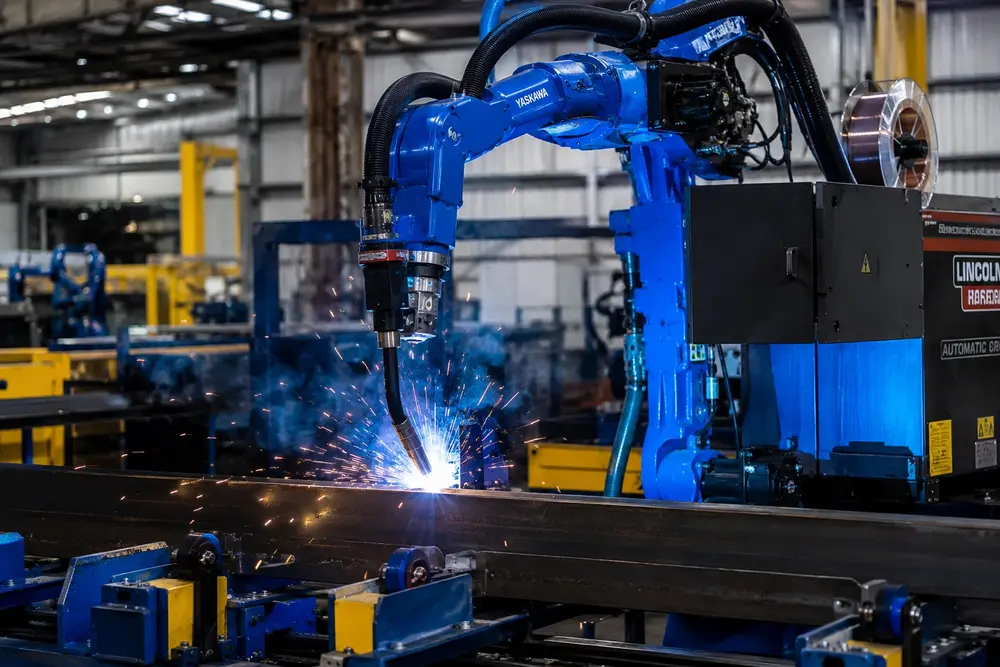
Automatic welding uses programmed equipment to control the welding torch position, travel speed, and parameters throughout the weld, rather than relying entirely on an operator’s hand movement and judgment. Processes like automated GTAW, GMAW, and plasma transferred arc (PTA) welding are commonly used for cladding and overlay work, where consistent deposition matters as much as the weld itself. Manual welding still has its place for repair work, awkward access, and one-off jobs, but automated systems excel wherever repeatability and volume are the priority.
Key Benefits of Working with an Automatic Welding Machine Supplier In Dubai
- Consistency. Automated systems apply the same parameters to every weld, reducing the variation between parts that is common with manual welding
- Higher productivity. Automated welding typically runs faster than manual welding for long, repetitive joints, shortening overall project timelines
- Fewer defects. Controlled, repeatable parameters reduce the risk of common defects like porosity, undercut, and incomplete fusion
- Improved safety. Operators are positioned away from direct arc exposure and welding fumes during automated cycles
- Better documentation. Automated systems can log parameters for every single weld, supporting quality records, traceability, and client audits
Where Automated Welding Delivers the Most Value
Automated welding is not the right choice for every job, but it delivers strong, measurable results in specific applications:
- Long, straight pipe welds where consistent travel speed and heat input matter throughout the joint
- PTA cladding and hardfacing, where uniform deposition thickness directly affects wear resistance
- High-volume repetitive welds on standardized components produced in batches
- Applications requiring detailed, traceable weld parameter records for regulatory or client compliance
Automation and Welding Trends Shaping the UAE Market
Welding automation continues to advance quickly, and UAE fabricators are paying close attention. Adaptive systems that use sensors to monitor the weld pool and adjust parameters in real time are reducing rework and expanding the range of jobs suited to automation, including joints that were once considered too variable for automated equipment. Laser and hybrid welding processes are also gaining ground in heavy fabrication, offering faster travel speeds with less distortion than traditional arc processes alone.
With major regional events like Middle East Energy — held in Dubai each September and drawing energy and industrial buyers from across the region — interest in automated welding technology across the UAE’s fabrication sector continues to grow, and suppliers are responding with more flexible, easier-to-program equipment.
What to Look for in an Automatic Welding Machine Supplier in Dubai
- Proven experience with your specific material, joint type, and application
- Qualified welding procedures already developed and approved for automated processes
- Technical support available for programming, setup, and troubleshooting
- Responsive after-sales service and ready availability of spare parts and consumables
Is Automated Welding Right for Your Project?
If your project involves repetitive welds, cladding, or high-volume production, automated welding is worth serious evaluation against your current manual process. For one-off repairs or highly variable geometry, manual or semi-automated welding may still be the more practical and cost-effective choice. A good supplier will help you make this decision honestly rather than pushing automation for every job regardless of fit.
Getting Started with an Automatic Welding Machine Supplier in Dubai
Before committing to automated welding, ask your supplier to review a sample of your typical parts and recommend where automation would genuinely add value versus where manual welding remains the better fit. Many clients start with a single high-volume or repetitive application, measure the results in defect rate and cycle time, and then expand automation to other parts of their production once the benefits are proven on real work. This staged approach reduces risk and gives your team time to adjust to new documentation and quality procedures that automated welding introduces.
It is also worth asking whether the supplier can support your project through the full lifecycle — from initial procedure qualification, through operator or programmer training if you plan to run the equipment in-house, to ongoing maintenance and calibration once the system is in regular production use. A supplier who only sells equipment, without this level of ongoing support, leaves clients to solve problems alone when something eventually needs adjustment or repair.

Conclusion
Working with an experienced automatic welding machine supplier in Dubai gives industrial clients the consistency, productivity, and documentation that manual welding alone cannot always match. Raysun Techno Industries LLC combines automated and manual welding capability, helping clients choose the right process for each application rather than a one-size-fits-all approach. Contact Raysun Techno Industries LLC today to discuss your automated welding requirements.
